

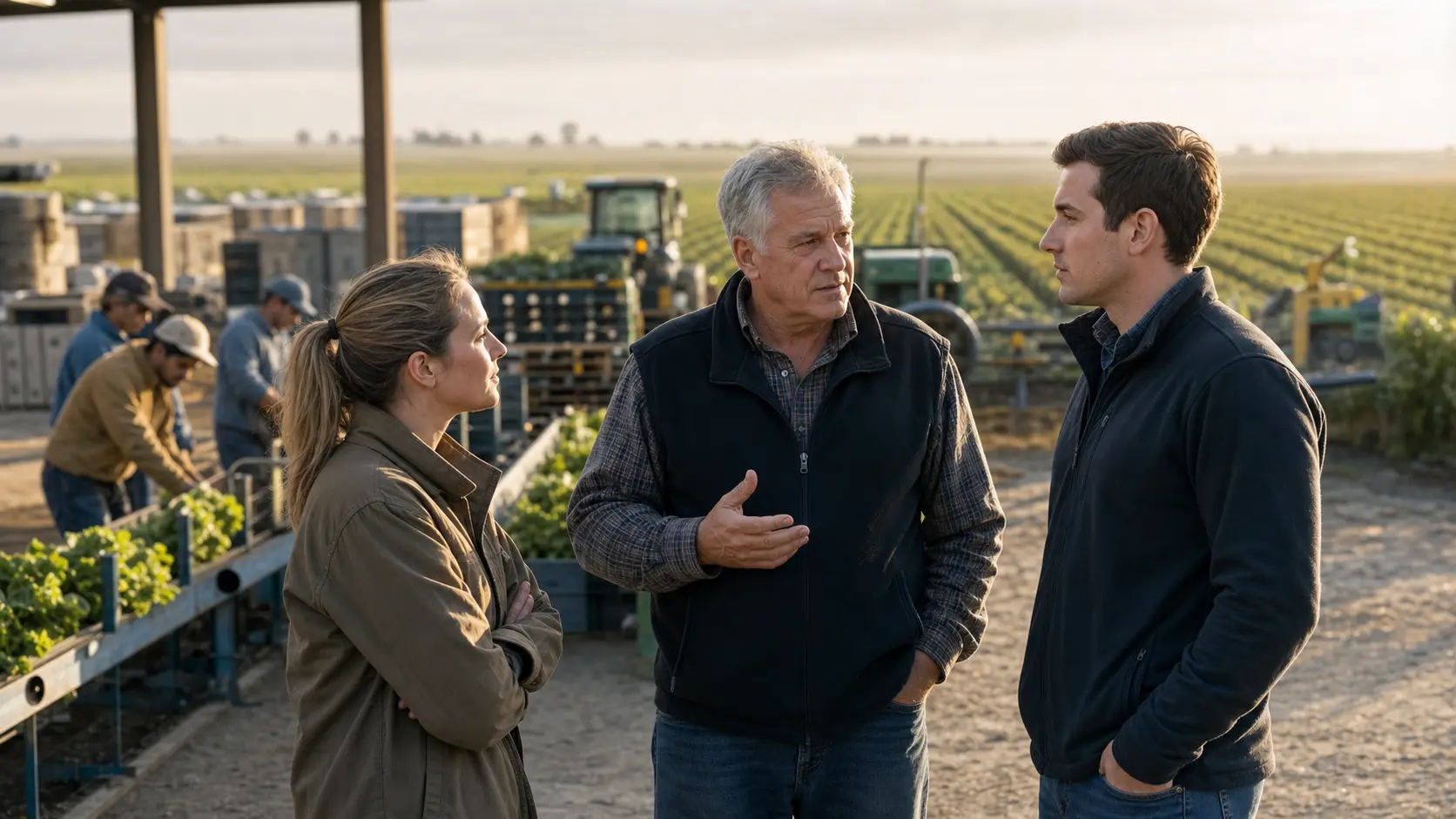
Agricultural employers face an aging workforce, rising labor costs, growing reliance on H-2A workers, and an urgent need to develop the next generation of operational leadership.
American agriculture is experiencing a workforce transition that extends far beyond the availability of seasonal labor.
Agricultural employers are managing rising wages, an aging workforce, greater reliance on temporary foreign workers, increasing regulatory responsibilities, and competition from industries that can offer more predictable schedules and working conditions.
At the same time, many farms and agricultural businesses are preparing for ownership, management, and generational transitions. New technology is changing the work performed in the field, while larger and more complex operations require stronger financial, operational, technical, and people-management capabilities.
These changes are creating a need for leaders who can manage today’s workforce while preparing the organization for what comes next.
Agricultural Employment Has Grown, but the Labor Market Remains Tight
Wage and salaried employment in U.S. agriculture increased from approximately 1.07 million jobs in 2010 to 1.18 million in 2024, a gain of 10 percent.
The largest increases occurred in agricultural support services and livestock production. Crop support services added approximately 48,400 jobs, an increase of 17 percent, while livestock employment added approximately 42,000 jobs, an increase of 19 percent.
These figures include workers employed by farms as well as businesses providing services such as labor contracting, custom harvesting, crop preparation, and farm management support.
The increase in employment does not mean that agricultural employers are finding it easy to fill positions. Several indicators point to a workforce that remains difficult and increasingly expensive to recruit.
USDA reports that the number of young, recently arrived immigrants entering agricultural work has declined. The hired workforce has become more settled, less migratory, and older. Real wages have also increased as producers compete for a smaller pool of available workers.
Agricultural employers are therefore managing two conditions at the same time:
- Employment has increased in important parts of the industry
- The supply of workers willing and able to perform agricultural work remains constrained
For employers, the challenge is no longer limited to finding enough people for the next harvest. It includes building a workforce strategy that supports productivity, retention, compliance, and business continuity.
Labor Costs Affect Some Agricultural Sectors More Than Others
Labor expenses are not distributed evenly across agriculture.
According to USDA, wages, salaries, and contract labor represented approximately 12 percent of production expenses for all farms in the 2022 Census of Agriculture.
For greenhouse and nursery operations, however, labor represented approximately 42 percent of production expenses. For fruit and tree nut operations, the share was approximately 40 percent.
This difference has important management implications.
A grain producer with highly mechanized operations may be less exposed to labor availability than a grower that depends on workers for pruning, thinning, harvesting, sorting, and packing. A dairy or livestock operation may have year-round staffing requirements that cannot be addressed through seasonal labor programs.
Labor-intensive employers must carefully evaluate:
- Wage and benefit levels
- Overtime and scheduling practices
- Employee housing and transportation
- Supervisor effectiveness
- Workforce productivity
- Retention and absenteeism
- Safety and workers’ compensation
- Labor contractor performance
- Mechanization opportunities
- H-2A program expenses and administration
A small change in labor productivity can have a significant financial effect when labor represents 40 percent or more of production expenses.
Cost reductions, however, must be evaluated carefully. Reducing staffing without improving processes or equipment may decrease output, increase injuries, weaken quality, or place additional pressure on experienced employees.
Agricultural Wages Continue to Rise
Real wages for nonsupervisory crop and livestock workers increased at an average annual rate of 1.2 percent between 1990 and 2024.
During the most recent 10-year period, real farm wages grew more quickly, increasing at an average annual rate of 1.9 percent per year. USDA describes this trend as consistent with reports that agricultural workers have become harder to find.
In 2024, the average wage for nonsupervisory farmworkers was approximately $18.13 per hour. Agricultural equipment operators averaged $19.07 per hour, while crop, nursery, and greenhouse workers averaged $18.24.
Average wages for hired agricultural managers reached $30.70 per hour in 2024, an increase of 6.6 percent from the prior year. First-line agricultural supervisors averaged $26.83 per hour, up 4.8 percent.
USDA forecasts total U.S. cash labor expenses of approximately $53.9 billion in 2026, an increase of $1.2 billion from the expected 2025 level. Labor is expected to remain one of the three largest farm production expense categories, along with livestock and poultry purchases and feed.
Higher wages are not automatically negative. Competitive compensation can improve recruitment, retention, and employee stability.
The leadership challenge is ensuring that increases in labor spending are supported by improvements in areas such as:
- Output per labor hour
- Yield and product quality
- Employee retention
- Equipment utilization
- Scheduling
- Training
- Safety
- Absenteeism
- Supervisor performance
The goal is not simply to minimize labor expense. It is to develop a workforce that produces reliable results at a sustainable cost.
H-2A Has Become a Major Part of the Agricultural Workforce
One of the clearest signs of agricultural labor scarcity is the growth of the H-2A temporary agricultural worker program.
USDA reports that certified H-2A positions increased from just over 48,000 in fiscal year 2005 to approximately 385,000 in fiscal year 2024, an increase of more than seven times.
The program continued to expand in fiscal year 2025. The U.S. Department of Labor certified 398,258 H-2A positions from 415,496 requested positions.
Approximately 82 percent of the certified positions were for crop, nursery, and greenhouse farmworkers. Agricultural equipment operators represented another 9.3 percent. Florida, Georgia, California, Washington, and North Carolina collectively accounted for about half of all certified positions.
H-2A can provide an essential source of seasonal labor, but it also creates substantial operational and administrative responsibilities.
Participating employers generally must:
- Demonstrate that sufficient U.S. workers are not available
- Meet application and recruitment deadlines
- Provide approved housing
- Arrange or reimburse qualifying transportation
- Comply with applicable wage requirements
- Maintain required documentation
- Coordinate worker arrival and departure
- Manage contracts and job duties accurately
- Prepare for government review or inspection
The program also has important limitations. Most crop employers may use H-2A for temporary or seasonal needs, but most livestock operations cannot use the program to fill year-round positions. Limited exceptions apply to livestock operations conducted on the range.
This means dairy, poultry, hog, and other year-round livestock employers may face persistent staffing needs without access to the same temporary labor option available to seasonal crop producers.
For organizations using H-2A at scale, workforce administration becomes a strategic management function rather than a routine human resources task.
The Workforce Is Aging at Multiple Levels
The aging of American agriculture affects both hired employees and farm ownership.
USDA found that the average age of foreign-born farmworkers increased by nearly seven years between 2006 and 2022. The decline in younger immigrant workers entering agriculture has contributed to the overall aging of the hired workforce.
Farm producers are also aging.
The 2022 Census of Agriculture counted approximately 3.37 million producers with an average age of 58.1 years. Producers age 65 and older represented 38 percent of all producers, while those under 35 represented only 9 percent.
Between 2017 and 2022:
- The number of producers age 65 and older increased 12.1 percent
- The number between ages 35 and 64 declined 9 percent
- The number under age 35 increased 3.9 percent
- The total number of producers remained relatively stable
The growth in younger and beginning producers is encouraging. More than 1 million producers had been farming for 10 years or fewer in 2022, representing approximately 30 percent of all producers.
Even so, the difference between the number of older and younger producers makes management transition an important issue.
The need is especially significant because approximately 96 percent of U.S. farms are classified as family farms. Family farms remain responsible for the majority of agricultural production, making continuity of ownership and management an industry-wide concern rather than a private family matter.
Succession Is More Than Transferring Ownership
Succession planning is often treated as a legal, tax, or estate-planning exercise. Those issues are important, but transferring ownership does not automatically transfer the knowledge required to operate the business successfully.
Experienced agricultural owners and managers may hold decades of knowledge about:
- Soil and field conditions
- Water availability
- Crop cycles
- Livestock performance
- Supplier relationships
- Equipment history
- Labor availability
- Customer expectations
- Seasonal cash flow
- Regulatory requirements
- Landowner relationships
- Weather-related risks
- Local infrastructure
Much of this knowledge may be informal and undocumented.
A successor may inherit land, equipment, contracts, and employees while still lacking the operating knowledge needed to make sound decisions. The risk is particularly high when one person has historically controlled purchasing, financial decisions, employee relations, production planning, and customer communication.
An effective succession plan should consider at least three separate transitions:
- Ownership transition, including equity, land, and financial control
- Management transition, including authority and decision-making
- Knowledge transition, including relationships, procedures, and operating history
These transitions do not always occur at the same time or involve the same people.
A family member may become an owner without becoming the general manager. An outside executive may be hired to professionalize operations while ownership remains within the family. A longtime operations manager may need to assume broader financial or commercial responsibilities.
Clear separation of these issues can help an organization choose the leadership structure that best supports its future.
Replacement Demand Will Continue Even as Employment Changes
The Bureau of Labor Statistics projects employment of farmers, ranchers, and other agricultural managers to decline 1 percent between 2024 and 2034.
Despite that projected decline, BLS expects approximately 85,500 openings per year. Those openings are expected to result from workers changing occupations or leaving the workforce, including retirement.
Agricultural worker employment is projected to decline 3 percent during the same period, but approximately 116,200 openings per year are still expected because existing workers will need to be replaced.
This distinction is important.
An industry does not need rapid employment growth to experience a serious hiring challenge. A stable or declining occupation can still produce tens of thousands of openings when experienced people retire or leave.
Replacement hiring may be particularly difficult in agriculture because qualified candidates often need a combination of:
- Product or commodity knowledge
- Geographic familiarity
- Employee management experience
- Mechanical or technical understanding
- Financial judgment
- Regulatory knowledge
- Willingness to work in a rural location
- Comfort with seasonal and unpredictable conditions
These requirements can substantially reduce the number of realistically qualified candidates.
Mechanization Is Changing Agricultural Work
Agricultural employment projections also reflect the increasing use of technology.
BLS expects automation and mechanization to limit demand for some traditional farmworker occupations. At the same time, the use of automated tractors, robotic harvesting systems, advanced irrigation, and other equipment is expected to increase demand for agricultural equipment operators relative to manual farm labor.
Technology can help employers address labor scarcity, improve consistency, and increase output. It also creates new workforce requirements.
An automated system may reduce the number of employees needed for one activity while increasing the need for:
- Equipment operators
- Maintenance technicians
- Data analysts
- Irrigation specialists
- Engineers
- Agronomists
- Food and agricultural scientists
- Technology-focused managers
Employment of agricultural and food scientists is projected to grow 6 percent from 2024 to 2034, with approximately 3,100 openings each year. These professionals help improve the efficiency, safety, and quality of agricultural and food production.
Agricultural engineering employment is also projected to grow 6 percent during the same period.
These occupations are relatively small, but their projected growth illustrates a broader change. Agricultural businesses increasingly need leaders who can connect traditional production knowledge with engineering, technology, data, and science.
Technology Does Not Eliminate the Need for Leadership
Purchasing equipment is only one part of mechanization.
Leaders must decide which operations should be automated, whether the technology is appropriate for local conditions, how it will be maintained, and whether the projected savings are realistic.
Implementation may require:
- Redesigning work processes
- Modifying fields or facilities
- Training employees
- Recruiting technical staff
- Establishing preventive maintenance
- Integrating data with existing systems
- Evaluating safety risks
- Measuring productivity
- Managing resistance to change
- Planning for equipment downtime
A technology investment can fail even when the equipment performs as designed. The organization may lack trained employees, reliable maintenance, operating discipline, or the data needed to measure results.
Agricultural leaders must therefore understand both the technology and the people responsible for using it.
Workforce Development Begins With Frontline Management
Employees often experience an organization through their direct supervisor.
A capable supervisor can improve communication, attendance, productivity, safety, and retention. An unprepared supervisor may increase turnover even when wages are competitive.
Frontline agricultural managers need the ability to:
- Set clear expectations
- Plan daily work
- Train employees
- Address performance problems
- Communicate across languages and cultures
- Enforce safety requirements
- Manage conflict
- Document employee issues
- Coordinate with human resources
- Recognize strong performance
Promoting the most experienced worker does not automatically produce an effective supervisor. Technical knowledge and people-management ability are separate capabilities.
Leadership development programs should prepare supervisors before the organization depends on them to manage large crews, expensive equipment, livestock, or time-sensitive harvest activity.
Leadership Priorities for Agricultural Employers
The workforce transition is increasing the value of several management capabilities.
Strategic Workforce Planning
Leaders must anticipate seasonal requirements, year-round staffing, retirements, technical skill needs, and future management vacancies.
Labor Compliance
Organizations need managers who understand the responsibilities associated with domestic employees, labor contractors, H-2A workers, housing, transportation, wages, safety, and documentation.
Supervisor Development
Strong frontline management can improve retention, productivity, communication, and workplace culture.
Operational and Financial Management
Agricultural leaders must connect production decisions with labor costs, yield, equipment utilization, cash flow, and profitability.
Technology Implementation
Managers need to determine where mechanization creates value and how the organization will operate and maintain new systems.
Knowledge Transfer
Critical operating knowledge should be documented and shared before an experienced owner or manager retires.
Succession Planning
Organizations should identify whether future leadership will come from family members, internal employees, outside professionals, or a combination of all three.
Cross-Functional Communication
Larger agricultural businesses require coordination among production, finance, human resources, food safety, maintenance, logistics, sales, and ownership.
Recruiting Leadership During an Agricultural Transition
Executive and management hiring requires significant organizational resources. SHRM’s 2026 recruiting benchmarks found a median executive cost per hire of $15,000 and a median executive time to fill of 45 calendar days. Participating organizations reported that the median percentage of executive positions filled externally was 100 percent.
Internal recruiting teams are also carrying heavier workloads. The median number of requisitions per recruiter increased from 20 in 2025 to 25 in 2026. Only 20 percent of surveyed organizations reported formally measuring quality of hire.
These figures are broad recruiting benchmarks and do not prove that an outside search firm will always reduce the cost or duration of a particular hire. Public research also does not provide enough direct comparison to claim that specialized agricultural recruiters universally outperform internal teams or general recruiting firms.
The value of specialization is better understood through the work required for a difficult agricultural search. A recruiter must determine whether candidates have experience with the correct commodity, production model, labor structure, geography, technology, customer base, and regulatory environment. A general title match may overlook major differences between managing a seasonal produce operation, a dairy, a livestock business, an agricultural distributor, or a vertically integrated food company.
An industry-specialized search firm can supplement an internal team by mapping the relevant market, directly recruiting passive candidates, and evaluating accomplishments within the realities of agriculture. For RJ Executive Search, that means looking beyond a candidate’s job title to determine whether the individual has successfully managed labor scarcity, improved productivity, developed supervisors, implemented technology, controlled costs, or helped an organization complete a leadership transition. A focused process can reduce time spent reviewing poorly aligned applicants and help ownership concentrate on candidates whose experience supports both immediate operations and long-term continuity.
Sources
- U.S. Department of Agriculture Economic Research Service, Farm Labor.
- U.S. Department of Agriculture Economic Research Service, Employment in U.S. Agriculture Grew 10 Percent Between 2010 and 2024.
- U.S. Department of Agriculture Economic Research Service, Farm Sector Income Forecast.
- U.S. Department of Agriculture National Agricultural Statistics Service, 2022 Census of Agriculture: Farm Producers.
- U.S. Department of Labor Office of Foreign Labor Certification, H-2A Selected Statistics, Fiscal Year 2025.
- U.S. Bureau of Labor Statistics, Farmers, Ranchers, and Other Agricultural Managers.
- U.S. Bureau of Labor Statistics, Agricultural Workers.
- U.S. Bureau of Labor Statistics, Agricultural and Food Scientists.
- U.S. Bureau of Labor Statistics, Agricultural Engineers.
- Society for Human Resource Management, 2026 Recruiting Executives Benchmarking: Attracting Critical Talent.