

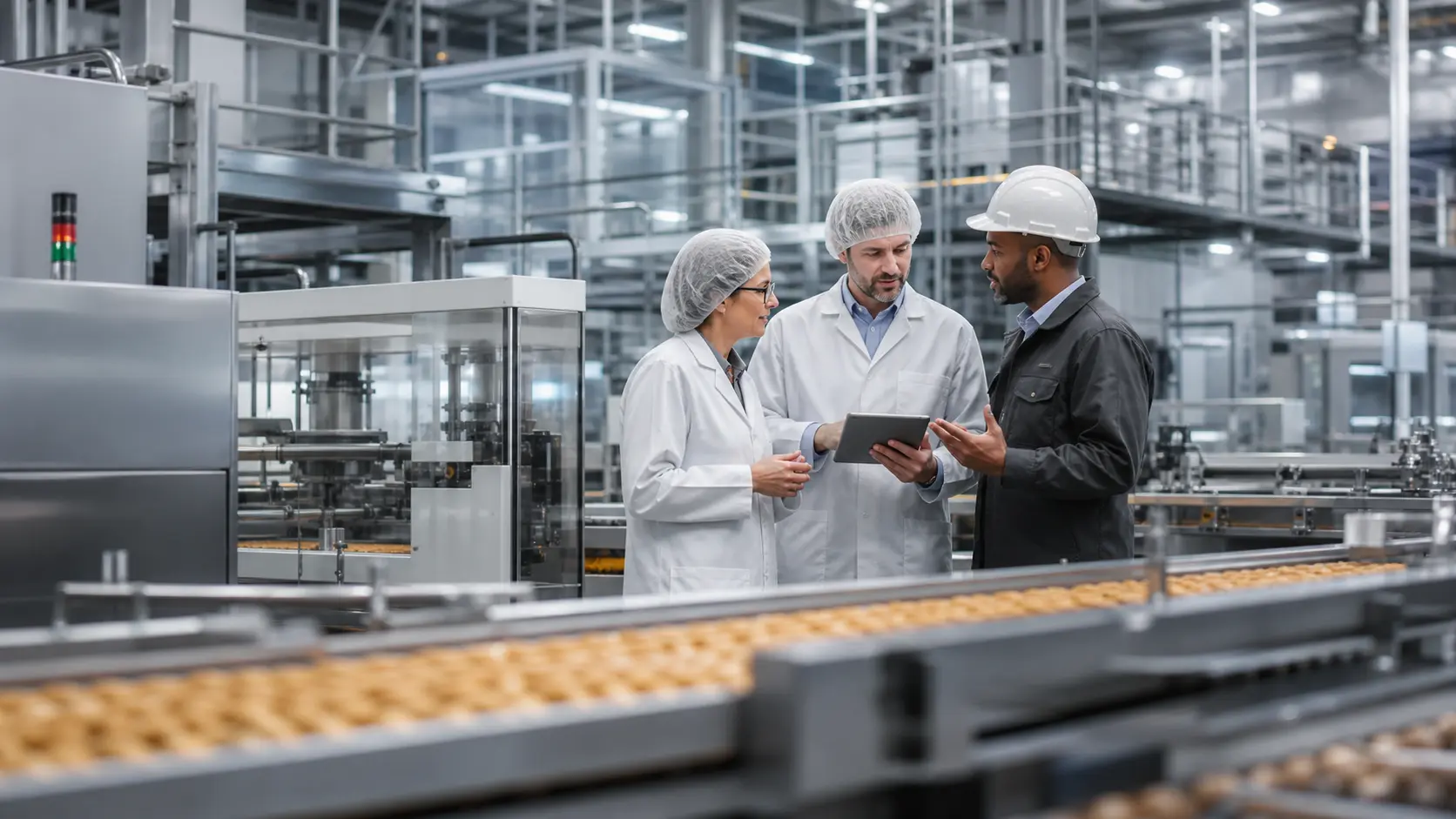
Food manufacturers are investing in automation, data, AI, and connected equipment, but realizing value requires leaders who can unite technology, operations, maintenance, and people.
Food manufacturers are investing in automation, connected equipment, data analytics, artificial intelligence, robotics, and digital supply chain systems.
The reasons are practical. Companies want to increase capacity, improve consistency, address labor shortages, strengthen food safety, reduce waste, and gain better visibility into their operations.
Technology can help accomplish those goals, but purchasing equipment or software does not guarantee operational improvement.
Successful implementation requires leaders who can identify the correct problem, build a realistic business case, prepare the workforce, manage installation, protect food safety, maintain the technology, and measure whether the investment produces the expected results.
For food manufacturers, automation is not simply an engineering project. It is an organizational change that affects operations, maintenance, quality, food safety, finance, human resources, information technology, and supply chain management.
Food Manufacturing Is Entering a More Technology-Intensive Period
The U.S. manufacturing sector employed more than 12.8 million workers in 2024. Overall manufacturing employment is projected to remain relatively stable through 2034, but several food and beverage categories are expected to grow faster than manufacturing as a whole.
Beverage manufacturing employment is projected to grow 11 percent between 2024 and 2034. Other food manufacturing is projected to grow 8 percent, animal food manufacturing 7 percent, and dairy product manufacturing and animal processing approximately 6 percent each.
Growth in output and employment creates pressure on companies to expand capacity without allowing labor, waste, downtime, or operating complexity to increase at the same rate.
Technology is increasingly being used to address that challenge.
An Institute of Food Technologists survey of 194 food, beverage, ingredient, distribution, consulting, and technology professionals found that approximately:
- 50 percent expected their companies to invest in artificial intelligence
- 48 percent expected investment in supply chain tracking systems
- About one-third expected investment in data analytics, robotics, process automation, cloud computing, or ERP systems
- 23 percent expected investment in mobile applications
- 22 percent expected investment in machine-learning software
- 21 percent expected investment in technology-enabled traceability systems
The leading reasons for investing included improving production efficiency, improving cost efficiency, and strengthening data-driven decision-making. Reducing labor costs was also identified as an important factor.
These investments indicate that food manufacturing is becoming more connected and information-intensive. They also increase the importance of leaders who understand both physical production and digital systems.
Automation Is Broader Than Robotics
Automation is often associated with robotic arms or fully automated production lines. In practice, it can include many different technologies.
Food manufacturers may automate:
- Mixing and batching
- Ingredient dispensing
- Cutting and forming
- Filling and portioning
- Cooking and temperature control
- Inspection
- Weighing
- Packaging
- Labeling
- Case packing
- Palletizing
- Material movement
- Warehouse replenishment
- Cleaning and sanitation monitoring
- Production data collection
- Quality documentation
- Traceability
- Preventive maintenance scheduling
Some projects replace repetitive manual activity. Others improve accuracy, visibility, safety, or consistency without substantially reducing headcount.
The National Institute of Standards and Technology identifies several potential benefits of manufacturing automation, including increased throughput, greater capacity, improved quality and yield, better employee safety, more consistent production, and the ability to move employees from repetitive tasks to higher-value work. Automation can also capture operational data that supports better decision-making.
The value of an automation project should therefore be measured against the specific operational problem it was intended to solve.
A system designed to improve food safety should not be evaluated only by labor savings. A robotic palletizer may be justified by injury reduction and workforce availability as well as throughput. A vision inspection system may create value by reducing complaints, rework, and rejected products.
Manufacturers Are Reporting Measurable Benefits
Deloitte’s 2025 Smart Manufacturing and Operations Survey included 600 executives from large manufacturers with U.S. headquarters or operations.
Although the survey covered multiple manufacturing sectors rather than food manufacturing alone, it provides useful context for how manufacturers are evaluating technology investments.
Among respondents:
- 92 percent believed smart manufacturing would be a primary driver of competitiveness during the next three years
- 85 percent believed smart manufacturing would transform production, improve agility, and help attract talent
- 49 percent identified operational benefits as the leading value sought
- 44 percent identified financial benefits as the second most important value
Respondents reported average improvements of:
- 10 to 20 percent in production output
- 7 to 20 percent in employee productivity
- 10 to 15 percent in unlocked production capacity
These are survey-reported results rather than guaranteed outcomes for every implementation. They demonstrate that meaningful gains are possible when technology is properly selected, integrated, and managed.
The survey also found that 88 percent of respondents expected smart manufacturing investment to continue or increase during the following fiscal year.
Technology investment is therefore unlikely to remain a temporary initiative. It is becoming an ongoing part of manufacturing strategy.
The Business Case Must Begin With a Defined Problem
Technology projects are more likely to succeed when the organization begins with a measurable operational need.
A company should not begin with the question, “Which robot should we buy?”
It should begin with questions such as:
- Where are we losing capacity?
- Which jobs are consistently difficult to staff?
- What is causing the most downtime?
- Where are quality defects or product losses occurring?
- Which manual activities create safety or ergonomic risk?
- Where does inaccurate information delay decisions?
- Which process limits the output of the entire facility?
- What customer requirements are difficult to meet consistently?
Once the problem is clearly defined, leaders can compare technology with other possible solutions.
The best answer may involve:
- Equipment changes
- Process redesign
- Additional training
- Preventive maintenance
- Better scheduling
- Improved raw materials
- Revised product specifications
- Changes in staffing
- Software
- Automation
- A combination of several approaches
Automating an unstable process can allow the company to produce defects or inefficiencies more quickly.
Strong leaders first establish whether the existing process is understood, controlled, and capable of producing consistent results.
Return on Investment Requires More Than Labor Savings
Many automation proposals emphasize the number of employees who may be reassigned or removed from a process.
Labor savings can be important, but they are rarely the complete business case.
A realistic return-on-investment analysis may include:
- Increased production capacity
- Reduced overtime
- Improved yield
- Lower giveaway
- Reduced product damage
- Fewer customer complaints
- Improved order accuracy
- Reduced downtime
- Lower workers’ compensation exposure
- Reduced employee turnover
- Better food safety controls
- Longer equipment life
- Reduced rework
- Faster product changeovers
- Lower sanitation time
- Improved energy or water efficiency
- Greater scheduling flexibility
The analysis should also include the complete cost of implementation.
Those costs may include:
- Purchase price
- Engineering
- Facility modifications
- Electrical, water, air, drainage, or refrigeration upgrades
- Software licenses
- Systems integration
- Installation
- Production downtime
- Training
- Spare parts
- Preventive maintenance
- Cybersecurity
- Technical staffing
- Vendor support
- Validation and documentation
A project with a low equipment price may still be expensive to operate. A more costly system may provide greater reliability, cleaner data, easier sanitation, or better long-term service.
Leadership must compare total lifecycle value rather than purchase price alone.
Food Manufacturing Creates Distinct Automation Requirements
Food manufacturing cannot always adopt technology in the same way as automotive, electronics, or metalworking facilities.
Food products may vary naturally in size, shape, moisture, temperature, texture, density, and composition. Equipment must also operate in environments involving water, sanitation chemicals, refrigeration, dust, oils, allergens, or biological materials.
Technology decisions may need to consider:
- Hygienic design
- Cleanability
- Allergen changeovers
- Microbial harborage risks
- Water and chemical exposure
- Product temperature
- Variability in raw materials
- Foreign-material prevention
- Regulatory requirements
- Washdown ratings
- Employee access for inspection
- Lot and batch traceability
- Recipe control
- Product holds and recalls
A system that performs well during a vendor demonstration may behave differently in continuous food production.
Variations in product consistency, packaging material, environmental temperature, or sanitation conditions can affect reliability. Leaders must evaluate equipment under realistic operating conditions and involve food safety, quality, sanitation, maintenance, and production employees before final selection.
Maintenance Determines Whether Automation Creates Capacity
Automation can reduce manual activity while increasing dependence on equipment.
When an automated system becomes a critical part of production, equipment availability becomes a direct constraint on revenue and customer service.
A company may install a faster packaging line but fail to improve output if the system experiences frequent faults or waits for outside technicians. A robot may reduce repetitive labor, but a failed sensor can stop the entire process if no one on-site can diagnose it.
The Bureau of Labor Statistics projects employment of industrial machinery mechanics, machinery maintenance workers, and millwrights to grow 13 percent from 2024 to 2034. Approximately 54,200 openings per year are projected across the economy.
BLS specifically identifies the continued adoption of automated machinery as a factor driving demand for these employees. Automated conveyors, motors, controls, and production systems require inspection, calibration, diagnosis, repair, and preventive maintenance.
Within manufacturing alone, industrial machinery mechanics are projected to add approximately 41,200 jobs between 2024 and 2034, more than any other occupation listed among the manufacturing sector’s largest projected employment gains.
This data reinforces an important point: automation does not eliminate maintenance work. It often makes maintenance capabilities more valuable.
Reliability Must Be Designed Into the Project
Maintenance should be involved before equipment is purchased, not after it is installed.
Maintenance and engineering teams can help evaluate:
- Component availability
- Vendor support
- Electrical and control standards
- Documentation
- Spare-parts requirements
- Remote access
- Diagnostic capabilities
- Sanitary maintenance access
- Expected service life
- Preventive maintenance requirements
- Compatibility with existing equipment
- Required employee skills
The organization should also determine who will support the equipment after installation.
Options may include:
- Existing maintenance employees
- Newly hired automation technicians
- Controls engineers
- Vendor service agreements
- System integrators
- Regional technical partners
- A combination of internal and outside resources
Dependence on a vendor may be reasonable for specialized systems. However, waiting several days for technical support may be unacceptable when the equipment controls a critical production bottleneck.
The leadership team must decide which capabilities should be retained internally and which can be outsourced.
Data Is the Foundation of Smart Manufacturing
Connected equipment can produce large amounts of information, but more data does not automatically result in better decisions.
Manufacturers may collect information about:
- Production counts
- Cycle times
- Downtime
- Temperature
- Pressure
- Weight
- Yield
- Rejects
- Energy consumption
- Maintenance conditions
- Product location
- Employee activity
- Inventory movement
The information becomes valuable only when it is accurate, available, understandable, and connected to a business decision.
Deloitte’s survey found that 57 percent of participating manufacturers used cloud computing at the facility or network level, and the same percentage used data analytics. Approximately 46 percent used industrial Internet of Things systems.
At the same time, only 54 percent reported using a unified data model, and 48 percent reported having a formal training and adoption standard.
This gap matters.
A company may have advanced equipment but still struggle to compare performance across lines because each machine uses different names, units, time periods, or reporting formats.
Leaders must establish:
- Clear definitions for operational measures
- Ownership of each data source
- Rules for correcting inaccurate information
- System integration standards
- Access permissions
- Reporting frequency
- Data-retention requirements
- Decision-making responsibilities
A dashboard is useful only when managers trust the information and know how to respond to it.
Industrial Engineers Help Connect Technology and Operations
The Bureau of Labor Statistics projects employment of industrial engineers to grow 11 percent between 2024 and 2034, with approximately 25,200 openings each year.
Industrial engineers design and improve systems that integrate employees, machinery, materials, information, energy, quality, and logistics. BLS identifies cost reduction, process optimization, automation, and supply chain improvement as important drivers of demand.
Within manufacturing, industrial engineers are projected to add approximately 25,600 jobs by 2034.
This type of systems expertise is especially valuable during automation projects.
An industrial engineer can help determine whether an individual machine improves the total operation or simply moves the bottleneck elsewhere.
For example, increasing the speed of a filler may create:
- Packaging congestion
- Insufficient cooling capacity
- More warehouse demand
- Additional sanitation requirements
- Quality inspection delays
- Increased utility use
- Greater maintenance workload
The equipment may perform exactly as intended while the facility produces no more finished product.
Leadership must evaluate the complete value stream rather than isolated machine speed.
Supply Chain Technology Must Connect With Plant Operations
Automation does not stop at the production line.
Food manufacturers are also investing in:
- Demand planning
- Procurement systems
- Warehouse management
- Transportation management
- Supplier monitoring
- Inventory tracking
- Product traceability
- Customer-order visibility
IFT’s industry survey found that 48 percent of respondents planned to invest in supply chain tracking systems. Respondents also identified supply chain production control, inventory management, and warehouse management among the business processes benefiting from digital transformation.
The BLS projects employment of logisticians to grow 17 percent from 2024 to 2034, with approximately 26,400 openings annually.
Food manufacturers need leaders who can connect production data with supply chain decisions.
A change in production speed may affect ingredient requirements, packaging supply, cold-storage capacity, transportation appointments, and customer delivery schedules.
Automation creates the most value when the plant, warehouse, procurement, and transportation systems operate from aligned information.
Artificial Intelligence Requires Strong Operational Foundations
Food companies are beginning to use artificial intelligence for applications such as:
- Demand forecasting
- Production scheduling
- Predictive maintenance
- Visual inspection
- Supplier risk analysis
- Quality trend detection
- Product formulation
- Inventory optimization
- Food safety monitoring
- Customer and market analysis
IFT’s survey found that 50 percent of participating food-industry professionals expected investment in artificial intelligence during 2025.
Deloitte found that 29 percent of surveyed large manufacturers had implemented AI or machine learning at the facility or network level. Another 23 percent were conducting pilots. Generative AI had been deployed at scale by 24 percent, while 38 percent were running pilots.
AI can identify patterns that employees may not easily recognize, but it depends on the quality of the information it receives.
An AI model cannot reliably correct:
- Missing production records
- Inconsistent downtime categories
- Incorrect inventory transactions
- Uncalibrated sensors
- Undefined quality standards
- Incomplete maintenance history
- Poorly controlled processes
Leaders should begin with clear operational questions, reliable data, and limited use cases where results can be measured.
Connected Equipment Introduces Cybersecurity Risk
Smart manufacturing connects equipment, software, sensors, vendors, and business systems.
These connections can increase visibility and control. They also create additional ways for unauthorized users or malicious software to affect the operation.
In Deloitte’s survey, 65 percent of respondents ranked operational risk as their first or second concern involving smart manufacturing initiatives. Within operational technology environments:
- 55 percent strongly agreed that unauthorized access was a major concern
- 47 percent identified intellectual property theft
- 46 percent identified operational disruption
Food manufacturers should evaluate cybersecurity when selecting and implementing equipment.
Important questions include:
- Does the vendor require remote access?
- How is remote access approved and monitored?
- Can the equipment operate safely if the network is unavailable?
- Are default passwords removed?
- Who controls software updates?
- How are backups maintained?
- Is the production network separated from general office systems?
- What happens if data is corrupted?
- Are former employees and vendors removed from access lists?
- Who is responsible for incident response?
Cybersecurity is not solely an information technology responsibility when a cyber incident can stop production, alter recipes, affect refrigeration, or interrupt traceability.
Operations, engineering, IT, food safety, and executive leadership must share responsibility for managing the risk.
Workforce Preparation Is Often the Most Difficult Part
Technology changes jobs even when it does not eliminate them.
Employees may need to learn how to:
- Operate touch-screen controls
- Interpret alarms
- Enter accurate production information
- Respond to equipment faults
- Perform basic troubleshooting
- Work safely around automated equipment
- Use digital work instructions
- Complete electronic quality records
- Maintain sensors and controls
- Analyze operational data
Deloitte found that 35 percent of surveyed manufacturers identified adapting employees to the factory of the future as a leading human-capital concern.
Approximately 48 percent reported moderate to significant difficulty filling production and operations management roles, while 46 percent reported difficulty filling planning and scheduling positions. Between 69 and 72 percent reported difficulty hiring for technical areas such as IT, operational technology, data science, engineering, application development, and cybersecurity.
The most commonly reported method of building digital capabilities was hiring new talent, cited by 68 percent of respondents. However, manufacturers also invested in internal development. More than half reported providing training for executives, and many used vendor or third-party courses.
These findings show why automation strategy must include workforce strategy.
Employees Should Be Involved Early
Employees who perform the work often understand exceptions, workarounds, product variation, and practical limitations that are not visible in a process diagram.
Involving operators, maintenance employees, sanitation teams, quality personnel, and supervisors can help identify:
- Difficult product variations
- Cleaning limitations
- Unsafe access points
- Common equipment faults
- Informal manual adjustments
- Training needs
- Product-handling concerns
- Realistic changeover requirements
Early participation can also improve employee acceptance.
Workers are more likely to support a system when they understand:
- Why the change is being made
- How their work will change
- What training will be provided
- Whether jobs will be eliminated or redesigned
- How performance will be measured
- Where employees can raise concerns
Leaders should not promise that technology will have no effect on employment when the future impact is uncertain. They should communicate clearly, explain the business need, and provide as much information as possible.
Change Management Determines Whether Technology Is Adopted
A project can be technically successful and still fail operationally.
Employees may continue using spreadsheets or paper records because the new system is difficult to use. Supervisors may bypass automated scheduling because they do not trust the recommendations. Maintenance teams may ignore condition-monitoring alerts because responsibilities are unclear.
Deloitte found that the major barriers to smart manufacturing included:
- Leadership support
- Technology investment
- Resource constraints
- Change management
- Employee adoption
- Value tracking
- Cross-functional collaboration
More than half of respondents had created a central team or working group to manage smart manufacturing initiatives. Approximately 45 percent developed formal communication processes, 44 percent created a center of excellence, and 42 percent developed value targets and measurement plans.
Technology implementation should therefore include:
- Clear executive ownership
- Defined business objectives
- Cross-functional participation
- Employee communication
- Training
- Pilot testing
- Performance measurement
- Formal accountability
- Post-implementation review
- Continuous improvement
The project is not complete when equipment begins operating. It is complete when the organization can sustain the new process and produce measurable results.
Operations and Technology Leadership Must Work Together
Deloitte found that 51 percent of smart manufacturing initiatives were led by operations executives such as chief operating officers or directors of operations. Technology leaders such as chief technology officers led 38 percent.
This division reflects the shared nature of the work.
Operations understands production requirements, employee capabilities, customer needs, and daily plant constraints.
Technology teams understand software, integration, networks, data architecture, cybersecurity, and systems governance.
Neither function can manage the transition effectively in isolation.
The strongest manufacturing leaders can translate between these groups. They do not need to personally program every control system or operate every production line, but they must understand enough to ask informed questions, identify risk, and coordinate decisions.
The New Food Manufacturing Leadership Profile
The growing use of automation is increasing the value of several leadership capabilities.
Operational Knowledge
Leaders must understand production flow, bottlenecks, yield, labor, quality, sanitation, maintenance, and customer requirements.
Financial Discipline
Executives should be able to evaluate total project cost, cash requirements, expected return, operational risk, and alternative investments.
Systems Thinking
Candidates must understand how a change in one area affects upstream and downstream operations.
Engineering and Technical Fluency
Leaders should be comfortable working with equipment, controls, data, software, vendors, and technical employees.
Food Safety Awareness
Automation decisions must consider sanitation, hygienic design, allergens, traceability, temperature, and regulatory controls.
Maintenance and Reliability
Leaders need to understand preventive maintenance, technical staffing, spare parts, vendor support, and equipment lifecycle management.
Data Literacy
Executives should be able to define useful measurements, evaluate data quality, and use information to improve decisions.
Cybersecurity Awareness
Connected manufacturing equipment requires leaders who understand operational technology risk and shared responsibility with IT.
Workforce Development
Leaders must prepare employees for new roles, develop technical skills, strengthen supervisors, and communicate changes clearly.
Change Management
Technology creates value only when employees adopt the new process and the organization sustains it.
Measurable Business Results
Strong candidates should be able to explain how they have:
- Increased throughput
- Improved yield
- Reduced downtime
- Lowered labor cost
- Reduced employee injuries
- Improved food safety controls
- Increased inventory accuracy
- Reduced waste
- Implemented automation
- Improved maintenance performance
- Integrated plant and ERP systems
- Developed technical employees
- Increased production capacity
- Completed a plant expansion
- Achieved an expected return on capital
Recruiting Leaders Who Can Convert Technology Into Results
The market for manufacturing leadership and technical talent remains selective.
BLS projects approximately 17,100 industrial production manager openings per year between 2024 and 2034, primarily because experienced managers will retire, change occupations, or otherwise leave their positions. Food manufacturing represented approximately 8 percent of industrial production manager employment in 2024, and the median annual wage for these managers in food manufacturing was $107,500.
SHRM reported a median executive cost per hire of $15,000 in 2026, along with a median executive time to fill of 45 calendar days. Recruiter workloads increased to a median of 25 active requisitions per recruiter. These benchmarks do not prove that an outside agency will always make a search faster or less expensive. They do show that executive hiring requires substantial sourcing, evaluation, coordination, and organizational attention.
Automation-focused leadership searches can be particularly difficult because similar titles may conceal very different experience. A candidate may have managed a highly automated facility without personally leading the transformation. Another may understand equipment but lack food safety, workforce, financial, or change-management experience.
A specialized search firm can supplement an internal team by directly recruiting passive candidates and evaluating whether they have delivered relevant results in food production, animal and poultry processing, agriculture, or distribution. For RJ Executive Search, the objective is to determine whether a candidate can connect technology with the full operation, including people, maintenance, food safety, data, supply chain, and financial performance. A focused process can reduce time spent interviewing candidates whose titles match the position but whose experience does not match the facility, product, workforce, and investment strategy.
Sources
- U.S. Bureau of Labor Statistics, Producing the Goods of the Future: Job Opportunities in Manufacturing.
- U.S. Bureau of Labor Statistics, Industrial Engineers, Occupational Outlook Handbook.
- U.S. Bureau of Labor Statistics, Industrial Machinery Mechanics, Machinery Maintenance Workers, and Millwrights, Occupational Outlook Handbook.
- U.S. Bureau of Labor Statistics, Logisticians, Occupational Outlook Handbook.
- U.S. Bureau of Labor Statistics, Industrial Production Managers, Occupational Outlook Handbook.
- Deloitte, 2025 Smart Manufacturing and Operations Survey: Navigating Challenges to Implementation.
- Institute of Food Technologists, Outlook 2025: Technology Trends.
- National Institute of Standards and Technology Manufacturing Extension Partnership, Robotics and Manufacturing Automation.
- Society for Human Resource Management, 2026 Recruiting Executives Benchmarking: Attracting Critical Talent.